homeDe Anza Properties logo
  • Schedule a visit
  • Communities
    East Bay & Sather Tower in Berkeley, CA
    South Bay
    San Francisco Bay Area

    Cupertino

    Forge Homestead Apartments

    The Cupertino Hotel Residences

    The Podium Apartments

    Los Altos

    Los Altos Gardens I

    Los Altos Gardens II

    Mountain View

    Gemello Village Apartments

    Palo Alto

    Portage

    San Jose

    Fruitdale Station Apartments

    Santa Clara

    Buckingham Place Apartments

    Catalina Luxury Apartments

    Flora Vista Apartments

    Stevens Creek Villas

    The Deck

    Warburton Village Apartments

    Sunnyvale

    Apricot Pit Apartments

    Cezanne Apartments

    Selo Of Pastoria

    San Francisco Bay Area Bridge in Fog
    San Francisco

    San Francisco

    Bluxome Place

    Metro At Showplace Square

    City Buildings
    West Hollywood Los Angeles

    Los Angeles

    Villa Doheny I & II

    Community Courtyard Gathering
    North County-Escondido San Diego

    Escondido

    Cross Creek Apartments

    City Neighborhood
    Salt Lake City Area, Utah

    Ogden

    Sun Chase Apartments

    Orem

    Midtown 360

    Salt Lake City

    Axis at 739 Apartments

    C9 Flats

    Costume Property Apartments

    Nexus on 9th

    Paragon Station

    Seven65 Lofts

    Sun River Apartments

    The Vue at Sugar House Crossing

  • About Us
  • News
  • Residents
  • Contact Us

An Architecture Lover’s Guide to the Bay Area: San Jose, Silicon Valley & San Francisco

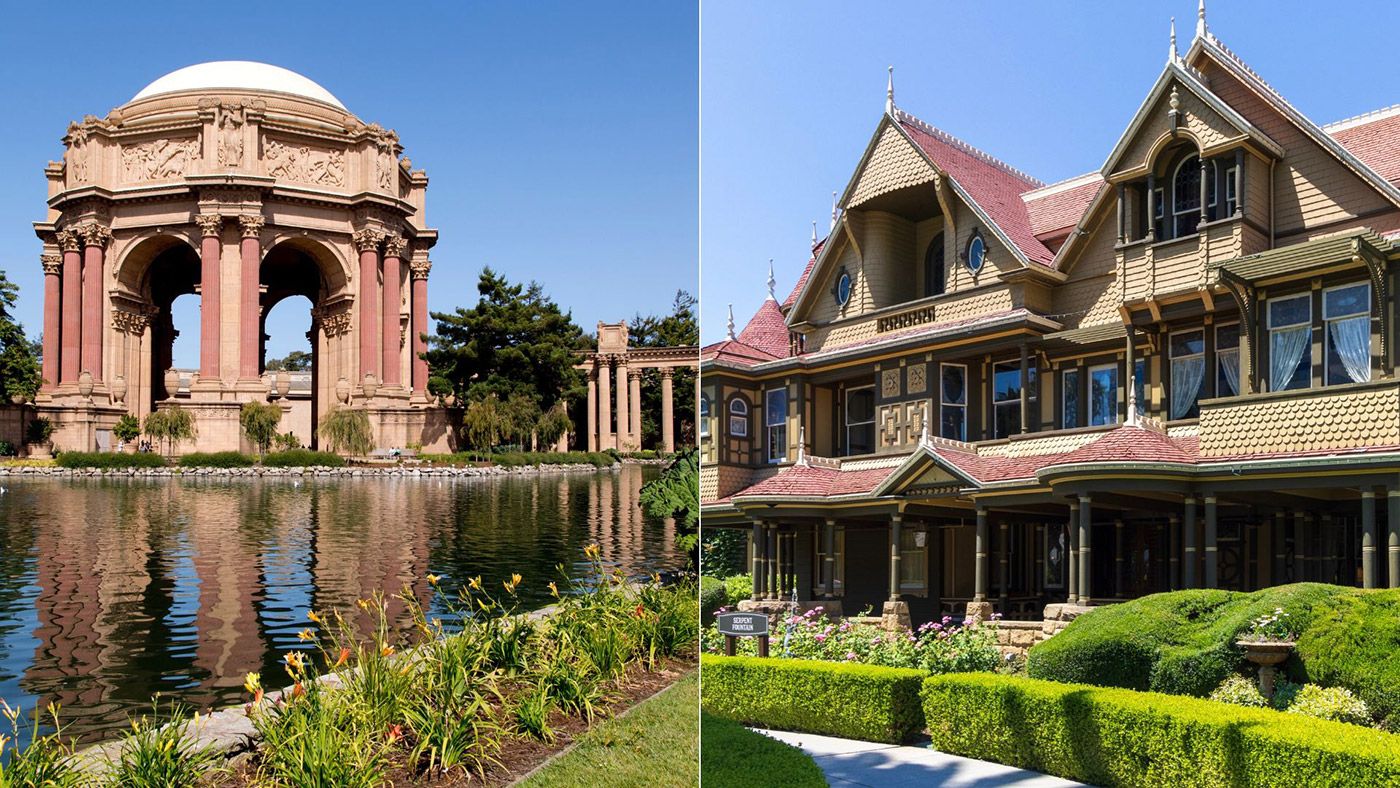
Split image featuring the Palace of Fine Arts in San Francisco and the Winchester Mystery House in San Jose, two iconic examples of Bay Area architecture.

For some people, architecture is art. Maybe not framed. Maybe not in a museum. But a form to be admired and visited. The South Bay and San Francisco offer architecture lovers a buffet of beauty.

You’ll find Victorian mansions, experimental mid-century homes, modern corporate headquarters, and buildings designed by some of America’s most influential architects. Frank Lloyd Wright worked here. So did Julia Morgan and Bernard Maybeck. More recently, architects such as Norman Foster and Richard Meier have added their own contributions.

Some of these buildings are familiar landmarks. Others are tucked away in residential neighborhoods, where you might pass them without realizing their significance.

Here’s our guide to some of the Bay Area’s most interesting architecture, from San Jose and Silicon Valley to San Francisco.

Extraordinary Homes: California's Residential Architecture

1. Hanna House, Stanford
map location: 737 Frenchmans Road, Stanford, CA 94305737 Frenchmans Road, Stanford, CA 94305

Historical Significance: Completed in 1937, Hanna House is one of Frank Lloyd Wright’s most unusual residential designs. Built for Stanford professor Paul Hanna and his wife, Jean, the house became known as the Honeycomb House because of its distinctive hexagonal layout.

Architect and Influence: Generally considered Usonian in style, Hanna House reflects Wright’s interest in natural materials, adaptable living spaces, and a close relationship between a house and its surroundings. The project is particularly notable for its departure from conventional rectangular construction.

Look for This: The hexagonal geometry extends throughout the house, influencing the walls, rooms, terraces, and furnishings. The design eliminates most conventional right angles.

Instagram Rating: 8/10. The hexagonal design gives you angles you won’t find in an ordinary house.

Can You Go Inside? Not right now. Hanna House normally offers guided tours, but it is temporarily closed for repairs and conservation. Stanford hasn’t announced a reopening date.

2. Greenmeadow Eichler Neighborhood, Palo Alto
map location: Greenmeadow Way and surrounding streets, Palo Alto, CA 94306Greenmeadow Way and surrounding streets, Palo Alto, CA 94306

Historical Significance: Built in 1954 and 1955, Greenmeadow contains 243 homes developed by mid-century master Joseph Eichler. The neighborhood helped establish a new model for suburban living, bringing modern architectural design to middle-class families.

Architect and Influence: A. Quincy Jones and Frederick Emmons designed the homes around principles of California modernism. Eichler believed modern architecture shouldn’t be limited to expensive custom houses.

Look for This: Low rooflines, exposed structural beams, large windows, and open floor plans are characteristic of the neighborhood’s homes, connecting living spaces with private outdoor areas.

Instagram Rating: 7/10. Eichlers photograph beautifully, but much of Greenmeadow’s best architecture faces the backyard rather than the street.

Can You Go Inside? No. Greenmeadow is a residential neighborhood, and the homes are privately owned. Visitors can appreciate the architecture from public streets.

3. Eichler X-100 House, San Mateo
map location: 1586 Lexington Avenue, San Mateo, CA 944021586 Lexington Avenue, San Mateo, CA 94402

Historical Significance: When the X-100 opened in 1956, it was promoted as a house of the future. An estimated 150,000 people toured it during its first three months. The experimental home was intended to demonstrate how steel construction and new technologies might change residential architecture.

Architect and Influence: Designed by A. Quincy Jones and Frederick Emmons for developer Joseph Eichler, the house departed from the wood-frame construction used in most Eichler developments. Its steel structure allowed for unusually open interior spaces.

Look for This: The flat roof and exposed steel framing distinguish the X-100 from conventional Eichlers. Inside, the architects incorporated extensive glass, indoor gardens, long skylights, and experimental kitchen equipment.

Instagram Rating: 9/10. The X-100 still manages to look futuristic almost 70 years later.

Can You Go Inside? Not normally. The house is privately owned but has occasionally been accessible during special events and real estate open houses.

4. Bernard Maybeck's Forest Hill Homes, San Francisco
map location: 270 Castenada Avenue, San Francisco, CA 94116270 Castenada Avenue, San Francisco, CA 94116


Historical Significance:
Forest Hill was developed in the early 20th century as one of San Francisco’s planned residential neighborhoods. Its winding streets and custom homes attracted several prominent architects, including Bernard Maybeck.

Architect and Influence: Maybeck was a leading figure in California’s Arts and Crafts movement, although his work drew from several architectural traditions. His houses often combine natural materials with European influences and unusual forms.

Look for This: At 270 Castenada, look at the steeply pitched roof, deep overhanging eaves, exposed wood framing, and the way the upper story projects beyond the level below it.

At 51 Sotelo, the broad gabled roof dominates the front of the house. Maybeck didn’t use one formula for his residential work.

Instagram Rating: 9/10. Your friends will admire your taste. They may also wonder how you know who Bernard Maybeck is.

Can You Go Inside? No. These are private residences. View them from the public sidewalk and respect the people who live there.

5. Julia Morgan's Sea Cliff Residence, San Francisco
map location: 50 Scenic Way, San Francisco, CA 9412150 Scenic Way, San Francisco, CA 94121


Historical Significance:
Built in 1921, Julia Morgan’s Sea Cliff residence is one of her many contributions to Bay Area residential architecture. Morgan was California’s first licensed female architect and designed hundreds of buildings during her career. Her best-known project is Hearst Castle, but her residential work extends throughout Northern California.

Architect and Influence: Morgan trained at the École des Beaux-Arts in Paris and became known for adapting historical architectural styles to individual clients and locations. Her work frequently emphasized craftsmanship, balanced proportions, and carefully selected materials.

Look for This: From the street, look at the steep red-tile roof, stucco exterior, arched openings, and the way Morgan divided the facade into several sections rather than creating one flat front.

Instagram Rating: 7/10. It’s a beautiful house, but landscaping and the fact that it’s a private residence limit your options.

Can You Go Inside? No. This is a private residence, and landscaping may limit the view from the street.

6. Haas-Lilienthal House, San Francisco
map location: 2007 Franklin Street, San Francisco, CA 941092007 Franklin Street, San Francisco, CA 94109

Historical Significance: Built in 1886, the Haas-Lilienthal House is one of San Francisco’s best-preserved Victorian residences. It survived the 1906 earthquake and fire and retains much of its original interior.

Architect and Influence: Peter R. Schmidt designed the house in the Queen Anne style, popular among wealthy San Francisco homeowners during the late 19th century. The style is known for asymmetrical forms, elaborate woodwork, and decorative details.

Look for This: The exterior features projecting bays, ornamental trim, and several different surface textures. Inside, visitors can see original woodwork, stained glass, period furnishings, and rooms that reflect upper-class domestic life in Victorian San Francisco.

Instagram Rating: 10/10. Victorian mansion. Stained glass. Elaborate woodwork. No filter necessary.

Can You Go Inside? Yes. San Francisco Heritage offers public house tours. Check its events schedule before visiting.

Architectural Experiments and Masterpieces

7. Apple Park, Cupertino
map location: 10600 N. Tantau Avenue, Cupertino, CA 9501410600 N. Tantau Avenue, Cupertino, CA 95014

Historical Significance: Opened in 2017, Apple Park is a major example of contemporary corporate architecture. Steve Jobs was closely involved in its development and envisioned a workplace that combined advanced engineering with extensive natural landscaping.

Architect and Influence: Foster + Partners, the firm founded by British architect Norman Foster, designed the campus in collaboration with Apple. The design emphasizes simplicity, precision, natural light, and a strong relationship between the building and its landscaped setting.

Look for This: The main building forms an enormous ring approximately one mile in circumference. Its curved glass panels are among the largest used in a building. Thousands of trees and large areas of open landscape surround the structure.

Instagram Rating: 3/10. It’s hard to appreciate the scale of Apple Park in a single photo. The building was designed to be seen from above, not from your phone.

Can You Go Inside? Not the headquarters itself. The Apple Park Visitor Center is open to the public and includes an architectural model of the campus and a rooftop terrace with views toward the property.

8. San Jose City Hall, San Jose
map location: 200 E. Santa Clara Street, San Jose, CA 95113200 E. Santa Clara Street, San Jose, CA 95113

Historical Significance: Completed in 2005, San Jose City Hall gave downtown a distinctly contemporary civic complex.

Architect and Influence: Richard Meier, winner of the Pritzker Architecture Prize, designed the complex. Meier is associated with geometric modernism and is particularly known for his use of white surfaces, glass, and carefully arranged architectural forms.

Look for This: The glass rotunda is the most recognizable feature. It sits between an 18-story office tower and a lower, three-story council wing. The contrast between the curved rotunda and the rectangular structures is central to the design.

Instagram Rating: 8/10. The glass rotunda gives you the shot. The wide plaza also makes it easy to get the whole building in the frame.

Can You Go Inside? Public areas are generally accessible during regular business hours, subject to security procedures and building schedules.

9. Palace of Fine Arts, San Francisco
map location: 3301 Lyon Street, San Francisco, CA 941233301 Lyon Street, San Francisco, CA 94123

Historical Significance: Originally built temporarily for the 1915 Panama-Pacific International Exposition, the Palace of Fine Arts was later recreated in permanent materials, with reconstruction carried out between 1964 and 1974.

Architect and Influence: Bernard Maybeck drew on classical architecture but wasn’t simply trying to reproduce an ancient building. He conceived the Palace as a romantic Roman ruin reflected in water.

Look for This: The monumental rotunda and colonnades get most of the attention, but the lagoon is part of the design. Walk around it and you’ll see how much the reflections and landscaping change the building from different angles.

Instagram Rating: 10/10. The rotunda, columns, lagoon and reflections do most of the work for you.

Can You Go Inside? The outdoor rotunda and colonnades are open to the public. The adjoining indoor spaces can be rented and used for performances or events, so interior access depends on what’s scheduled.

10. Stanford Memorial Church and Main Quad, Stanford
map location: 450 Jane Stanford Way, Stanford, CA 94305450 Jane Stanford Way, Stanford, CA 94305

Historical Significance: Completed in 1903, Memorial Church is one of Stanford University’s most significant historic buildings. Jane Stanford commissioned it in memory of her husband, Leland Stanford. The surrounding Main Quad is part of the university’s original architectural plan.

Architect and Influence: Memorial Church developed from conceptual drawings by Charles Allerton Coolidge, which San Francisco architect Clinton Day updated for construction. The church and surrounding Quad draw on Romanesque and Mission-inspired architectural traditions.

Look for This: The church’s facade features elaborate mosaics, stone carvings, and decorative arches. Throughout the Main Quad, covered arcades, sandstone buildings, and red-tile roofs create a consistent architectural style.

Instagram Rating: 9/10. The mosaics are the obvious shot, but the long arcades may photograph even better.

Can You Go Inside? The Main Quad is generally accessible. Memorial Church is currently closed to visitors for maintenance, although some religious and university functions continue. Check Stanford’s website for updated visitor access.

Historic Architecture Worth Rediscovering

11. Winchester Mystery House
map location: 525 S Winchester Blvd, San Jose, CA 95128525 S Winchester Blvd, San Jose, CA 95128

Historical Significance: The Winchester Mystery House began as an eight-room farmhouse purchased by Sarah Winchester in 1886. Over the next several decades, the property evolved into one of California’s most unusual and recognizable residences.

Architecture and Influence: Expanded on continuously between 1886 and 1922, the home combines Victorian and Gothic Revival influences with architectural experiments thought up by Sarah. Early communication systems, modern conveniences, stained glass, and custom millwork show the changing approaches to residential design during the time.

Look for This: Look for intricate stained-glass windows, handcrafted woodwork, and decorative detailing found throughout the mansion. You can make a game out of spotting all the East Asian details alongside touches inspired by Persian, Moorish, Romanesque, and Egyptian design traditions. Turns out decades of continuous additions produce some interesting architectural combinations.

Instagram Rating: 10/10. Victorian architecture, elaborate craftsmanship, beautifully maintained gardens, and a house with a reputation for being haunted. Difficult combination to beat.

Can You Go Inside? Yes. Guided tours are available throughout the year and will get you access to many of the mansion’s best rooms and features. If visiting in October, you’ll find the property’s reputation is still very much part of the experience.

12. Gonzales/Peralta Adobe, San Jose
map location: 184 W. St. John Street, San Jose, CA 95110184 W. St. John Street, San Jose, CA 95110

Historical Significance: Built in 1797, the Gonzales/Peralta Adobe is the oldest surviving building in San Jose and the last remaining structure from the original Pueblo de San José de Guadalupe.

Architect and Influence: The building reflects Spanish colonial construction traditions. Adobe structures used locally available earth and relatively simple building techniques suited to California’s climate.

Look for This: The thick adobe walls, modest windows, and simple exterior are characteristic of early California residential architecture. Compare it with the much more elaborate Fallon House nearby.

Instagram Rating: 6/10. Historically fascinating. Visually, it’s a small adobe building. Context helps.

Can You Go Inside? Yes, by guided tour. History San José generally offers tours on Saturdays and Sundays. Advance booking is recommended to secure a docent, and visitors should check the current schedule before going.

13. Carmela and Thomas Fallon House, San Jose
map location: 175 Sharks Way, formerly 175 W. St. John Street, San Jose, CA 95110175 Sharks Way, formerly 175 W. St. John Street, San Jose, CA 95110

Historical Significance: Built in the 1850s, the Fallon House reflects San Jose’s growth during California’s early statehood years. Its location near the Peralta Adobe makes it possible to compare two very different periods of residential architecture.

Architect and Influence: The house follows mid-19th-century American residential design traditions, with wood-frame construction, formal proportions, and decorative details that contrast with the earlier adobe.

Look for This: Compare the wood-frame construction, larger windows, porch, and decorative exterior details with the much simpler adobe next door. Seeing the two together makes the change in San Jose’s residential architecture easy to spot.

Instagram Rating: 8/10. The porch and Victorian details make the Fallon House considerably more camera-friendly than its neighbor.

Can You Go Inside? Yes, by guided tour. History San José generally offers tours on Saturdays and Sundays. Advance booking is recommended to secure a docent.

A Different Way to See the Bay Area

The Bay Area's architectural history covers several centuries, but you don't have to visit a museum to appreciate it.

You can see Frank Lloyd Wright's experiments with geometry at Stanford, explore neighborhoods that helped popularize mid-century modern homes, or find the work of Julia Morgan and Bernard Maybeck along San Francisco's residential streets.

Apple Park adds a contemporary chapter, combining its enormous ring-shaped design with advanced glass engineering and extensive landscaping.

Some of these buildings welcome visitors. Others are private homes best appreciated from the sidewalk. Either way, they offer a different perspective on the communities that make the Bay Area distinctive.

Corner view of Bluxome Place in San Francisco’s SoMa neighborhood featuring dramatic floor-to-ceiling windows, brick architecture, and loft-style design.
Bluxome Place in San Francisco’s SoMa neighborhood combines industrial-inspired architecture, expansive windows, and loft-style design, reflecting the area’s evolution from warehouse district to one of the city’s most vibrant residential communities.

At De Anza Properties, we appreciate the architecture and history that give San Francisco and South Bay neighborhoods their character. Whether you're interested in a historic home, a mid-century design, or something more contemporary, the region offers plenty of inspiration.

Looking for a new home? Contact Us:

Contact Form on single blog post

Recent Posts

  • San Jose Museum of Art on an overcast day in downtown San Jose, one of the many indoor attractions featured in this rainy-day activities guide.
    Best Rainy Day Things to Do Near San Jose: 11 Fun Indoor Activities
    post dateOctober 13, 2026
  • Clipper card and South Bay transit services including BART, Caltrain, and VTA light rail.
    South Bay Public Transportation Guide: Tips for New Residents
    post dateSeptember 15, 2026
  • Aerial view of downtown San Jose, California with surrounding neighborhoods and mountains in the distance.
    9 Charming Towns Near San Jose Worth Exploring
    post dateAugust 18, 2026

View Our Communities

North County-Escondido San Diego
Salt Lake City Area, Utah
San Francisco
South Bay - San Francisco Bay Area
West Hollywood Los Angeles
homeDe Anza Properties logo

960 N San Antonio Rd, Suite 114
Los Altos, CA 94022
phone CALL (650) 209-3232

  • Communities
    • Los Angeles Apartments
    • San Francisco Apartments
    • South Bay & San Jose Apartments
    • Salt Lake City Area Apartments
    • San Diego Apartments
  • News
  • About Us
  • Contact Us
  • Residents
  • Careers
equal housing opportunity logo
© copyright - De Anza Properties. All rights reserved.
privacy policy   |   terms & conditions

Schedule a visit

reCAPTCHA is required.